

Did The Ozone Layer Repair Itself
The ozone layer is one layer of the stratosphere, the 2nd layer of the Earth's atmosphere. The stratosphere is the mass of protective gases clinging to our planet. The stratosphere gets its name considering information technology is stratified, or layered: as superlative increases, the stratosphere gets warmer. The stratosphere increases in warmth with elevation because ozone gases in the upper layers absorb intense ultraviolet radiation from the sun. Ozone is only a trace gas in the atmosphere—only about iii molecules for every 10 million molecules of air. But it does a very important job. Similar a sponge, the ozone layer absorbs $.25 of radiations hit Earth from the sun. Even though we need some of the sun's radiation to live, besides much of information technology tin damage living things. The ozone layer acts as a shield for life on Globe. Ozone is good at trapping a type of radiations chosen ultraviolet radiation, or UV light, which can penetrate organisms' protective layers, like peel, damaging Dna molecules in plants and animals. There are 2 major types of UV light: UVB and UVA. UVB is the crusade of skin atmospheric condition like sunburns, and cancers like basal cell carcinoma and squamous cell carcinoma. People used to recall that UVA lite, the radiations used in tanning beds, is harmless because information technology doesn't cause burns. Nonetheless, scientists now know that UVA low-cal is even more harmful than UVB, penetrating more securely and causing a deadly pare cancer, melanoma, and premature crumbling. The ozone layer, our Earth'south sunscreen, absorbs about 98 percent of this devastating UV light. The ozone layer is getting thinner. Chemicals called chlorofluorocarbons (CFCs) are a reason we take a thinning ozone layer. A cfc (Chlorofluorocarbon) is a molecule that contains the elements carbon, chlorine, and fluorine. CFCs are everywhere, by and large in refrigerants and plastic products. Businesses and consumers apply them because they're cheap, they don't catch fire easily, and they don't commonly poison living things. But the CFCs first eating away at the ozone layer once they get blown into the stratosphere. Ozone molecules, which are simply made of iii joined oxygen atoms, are e'er being destroyed and reformed naturally. But CFCs in the air arrive very difficult for ozone to reform once it's broken apart. The ozone layer, which just makes up 0.00006 percent of Earth's atmosphere, is getting thinner and thinner all the time. "Ozone holes" are popular names for areas of damage to the ozone layer. This is inaccurate. Ozone layer damage is more like a really thin patch than a hole. The ozone layer is thinnest near the poles. In the 1970s, people all over the world started realizing that the ozone layer was getting thinner and that this was a bad affair. Many governments and businesses agreed that some chemicals, like aerosol cans, should be outlawed. There are fewer aerosol cans produced today. The ozone layer has slowly recovered as people, businesses, and governments work to control such pollution.
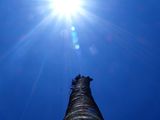
The corporeality of ozone in the atmosphere is measured in "Dobson units."
Photograph past Suzailan Shoroyo, MyShot
One thousand thousand to One
Compared to other gases in the atmosphere, ozone is pretty rare. Co-ordinate to NOAA, there are but well-nigh iii molecules of ozone for every ten million molecules of air.
aerosol tin can
Noun
container of liquid material nether high pressure. When released through a small-scale opening, the liquid becomes a spray or cream.
Noun
layers of gases surrounding a planet or other celestial torso.
cancer
Noun
growth of abnormal cells in the trunk.
chlorofluorocarbon (CFC)
Noun
chemical compound generally used in refrigerants and flame-retardants. Some CFCs have destructive effects on the ozone layer.
cling
Verb
to attach or stick to.
consumer
Substantive
person who uses a good or service.
harm
Noun
harm that reduces usefulness or value.
devastate
Verb
to destroy.
Dna
Noun
(deoxyribonucleic acrid) molecule in every living organism that contains specific genetic information on that organism.
chemical element
Noun
chemical that cannot be separated into simpler substances.
Substantive
elevation to a higher place or below sea level.
gas
Substantive
state of matter with no fixed shape that volition make full whatever container uniformly. Gas molecules are in constant, random motility.
government
Noun
system or order of a nation, state, or other political unit.
inaccurate
Adjective
untrue.
melanoma
Substantive
dangerous and sometimes fatal peel cancer.
molecule
Noun
smallest physical unit of measurement of a substance, consisting of two or more than atoms linked together.
outlaw
Verb
to make illegal or against the police force.
oxygen
Substantive
chemic element with the symbol O, whose gas grade is 21% of the Globe's temper.
ozone hole
Noun
circular pattern, usually located near the Antarctic, of thin atmospheric ozone, which absorbs harmful ultraviolet sunlight.
Noun
layer in the temper containing the gas ozone, which absorbs well-nigh of the sunday's ultraviolet radiations.
penetrate
Verb
to button through.
plastic
Substantive
chemical material that tin be easily shaped when heated to a high temperature.
toxicant
Noun
substance that harms health.
pole
Noun
extreme north or south point of the Globe'south centrality.
Noun
introduction of harmful materials into the environment.
radiation
Noun
free energy, emitted equally waves or particles, radiating outward from a source.
refrigerant
Noun
substance used to continue materials cool.
skin
Noun
soft external roofing of some animals.
sponge
Noun
substance that hands absorbs other cloth.
stratify
Verb
to separate into layers.
stratosphere
Noun
level of Globe's atmosphere, extending from 10 kilometers (6 miles) to l kilometers (31 miles) above the surface of the Earth.
ultraviolet radiation
Substantive
powerful lite waves that are too short for humans to see, merely can penetrate Earth'south temper. Ultraviolet is often shortened to UV.
UVB
Noun
type of ultraviolet (UV) radiations that can cause sunburn, skin cancer, and types of heart damage.
volcanic eruption
Noun
activeness that includes a belch of gas, ash, or lava from a volcano.

Source: https://www.nationalgeographic.org/encyclopedia/ozone-layer/
Posted by: benningthatiand73.blogspot.com
0 Response to "Did The Ozone Layer Repair Itself"
Post a Comment